



200 Years of Matica Srpska
Title: 200 Years of Matica Srpska
Date of Issue: 18.03.2026.
Author: Nebojsa Djumic
Type edition: commemorative
Printing techniques: multicolour offset
Sheet: 8+1
Paper: muflep 100g
Printing House: Blicdruk, Sarajevo
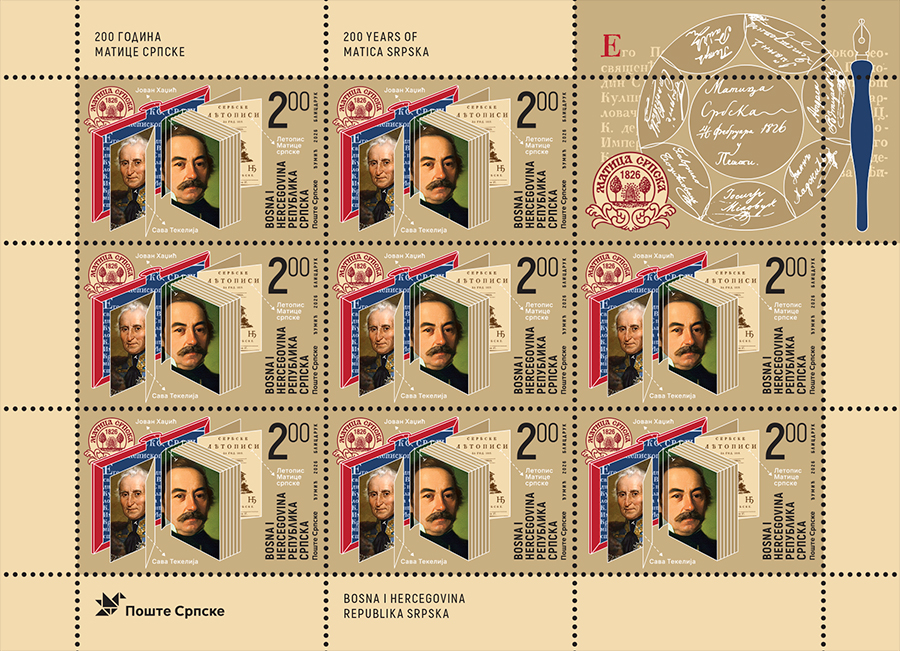

 Motive: Jovan Hadzic, Savo Tekelija, Chronicle of Matica Srpska
Catalogue no.: 1018
Perforation: 13 3/4
Face value: 2.00 BAM
Quantity: 8 000
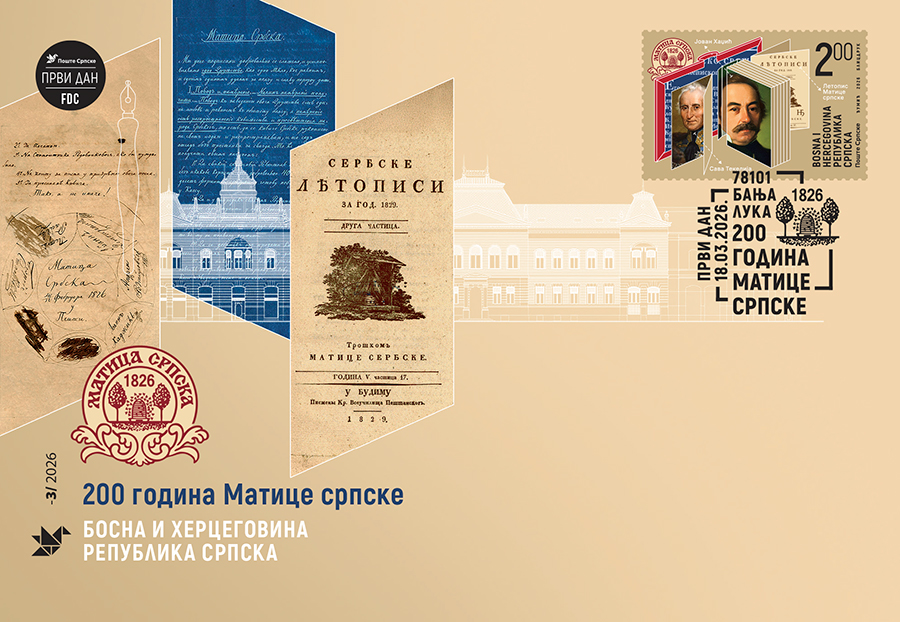
Matica Srpska is the oldest Serbian cultural, scientific and literary institution. It was founded in 1826 in Pest and is one of the oldest of its kind in Europe. The main mission of Matica Srpska since its foundation has been the teaching of the Serbian language, literature, science and art. From the very beginning, its activities have been focused on presenting Serbian culture in Europe, and on the other hand, on educating people. To this end, it has developed a rich publishing activity. The basis was famous "Chronicle" launched in 1824.
In 1864, the Matica moved to Novi Sad, which became known as the Serbian Athens. The city was given that name because it was believed that the most educated and wise people gathered around the Matica Srpska. The Matica became a symbol of civil society, high culture, enlightenment and charity. It was and remained a national institution, and the connection within it was the noble idea of creating a single, unified hive and the attitude that it was an honor to serve the honorable Matica Srpska. Thousands of people followed this idea. Among them were members of other nations. It was precisely thanks to this broad support from the people that the Matica was at one time the richest endowment institution in Hungary. Its funds financed capital projects of importance for the standardization of the Serbian language and for the development of various scientific disciplines. At the same time, Matica took care of the education of gifted pupils and students, and thus of the creation of the Serbian intellectual elite. During its long history, Matica also initiated numerous scientific projects, among which the creation of a Serbian language dictionary, encyclopedias and lexicons stand out. These capital projects made an immeasurable contribution to the systematization of knowledge and the development of Serbian science.
Today, Matica is a significant institution that brings together prominent scientists and artists, preserves cultural heritage and actively participates in contemporary cultural life. Its work testifies to its enduring commitment to preserving national identity and developing the culture and science of the Serbian people.
Author: Nebojsa Djumic
Publisher: Poste Srpske a.d. Banjaluka