



Famous People 2025
TitleFamous people
Date of Issue: 05.11.2025.
Author: Danijela Popovic
Type edition: commemorative
Printing techniques: multicolour offset
Sheet: 9
Paper: muflep 100g
Printing House: Blicdruk, Sarajevo
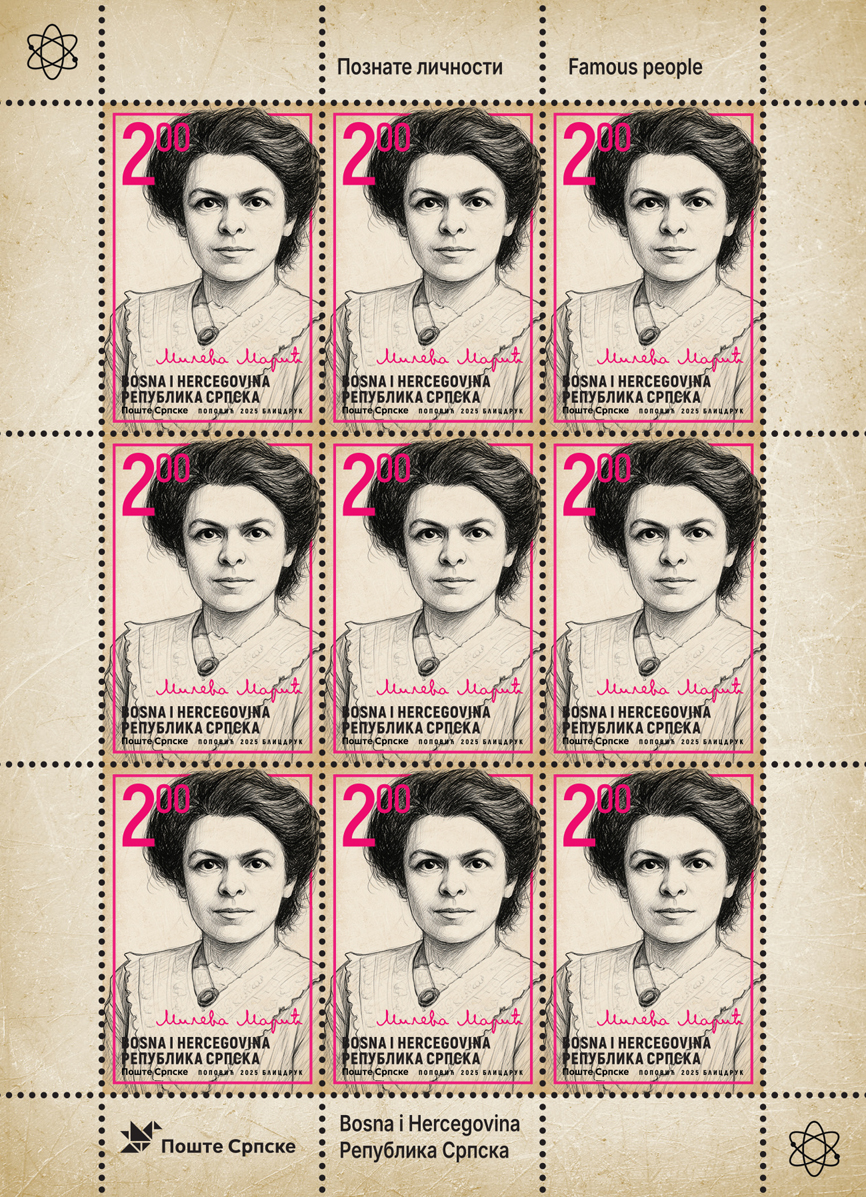
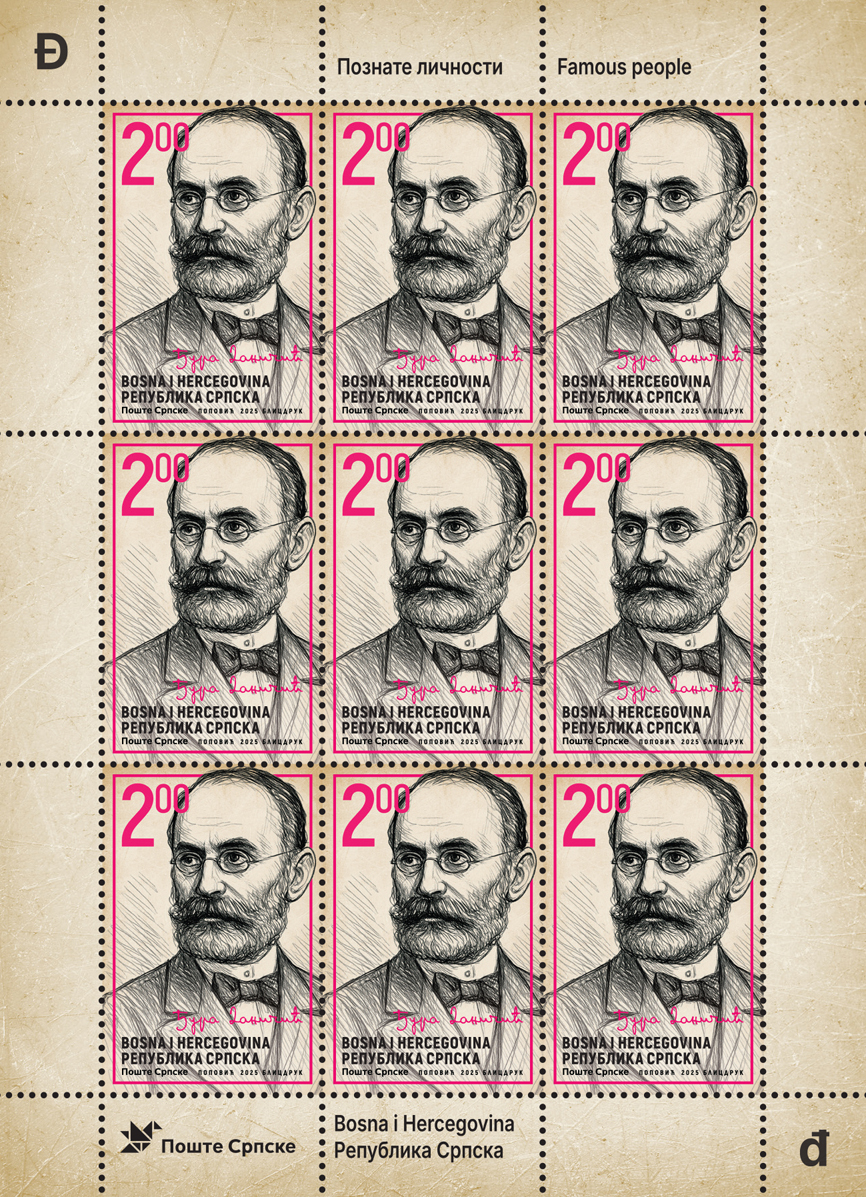
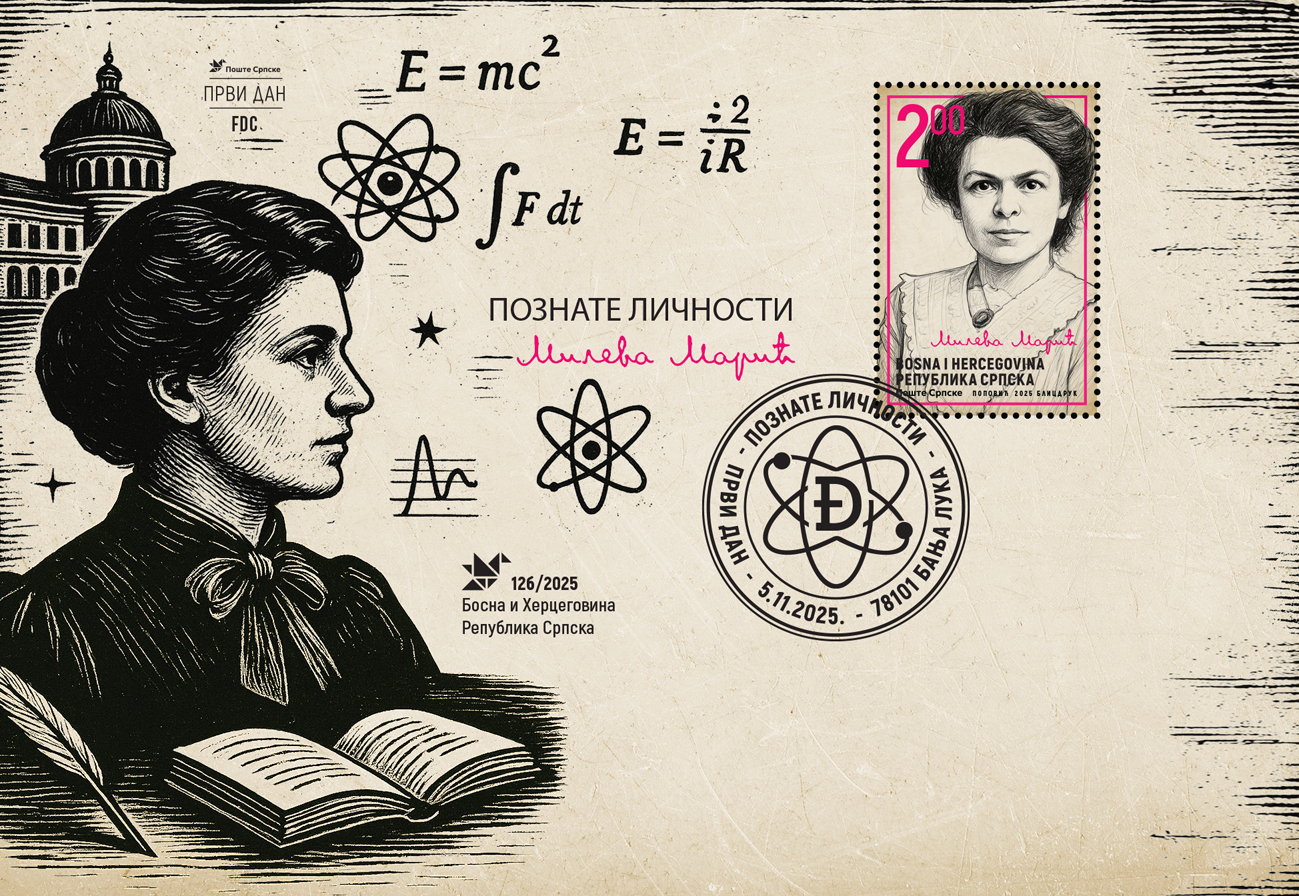
Motive: Mileva Maric
Catalogue no.: 1011
Perforation: 13 3/4
Face value: 2.00 BAM
Quantity: 8 000
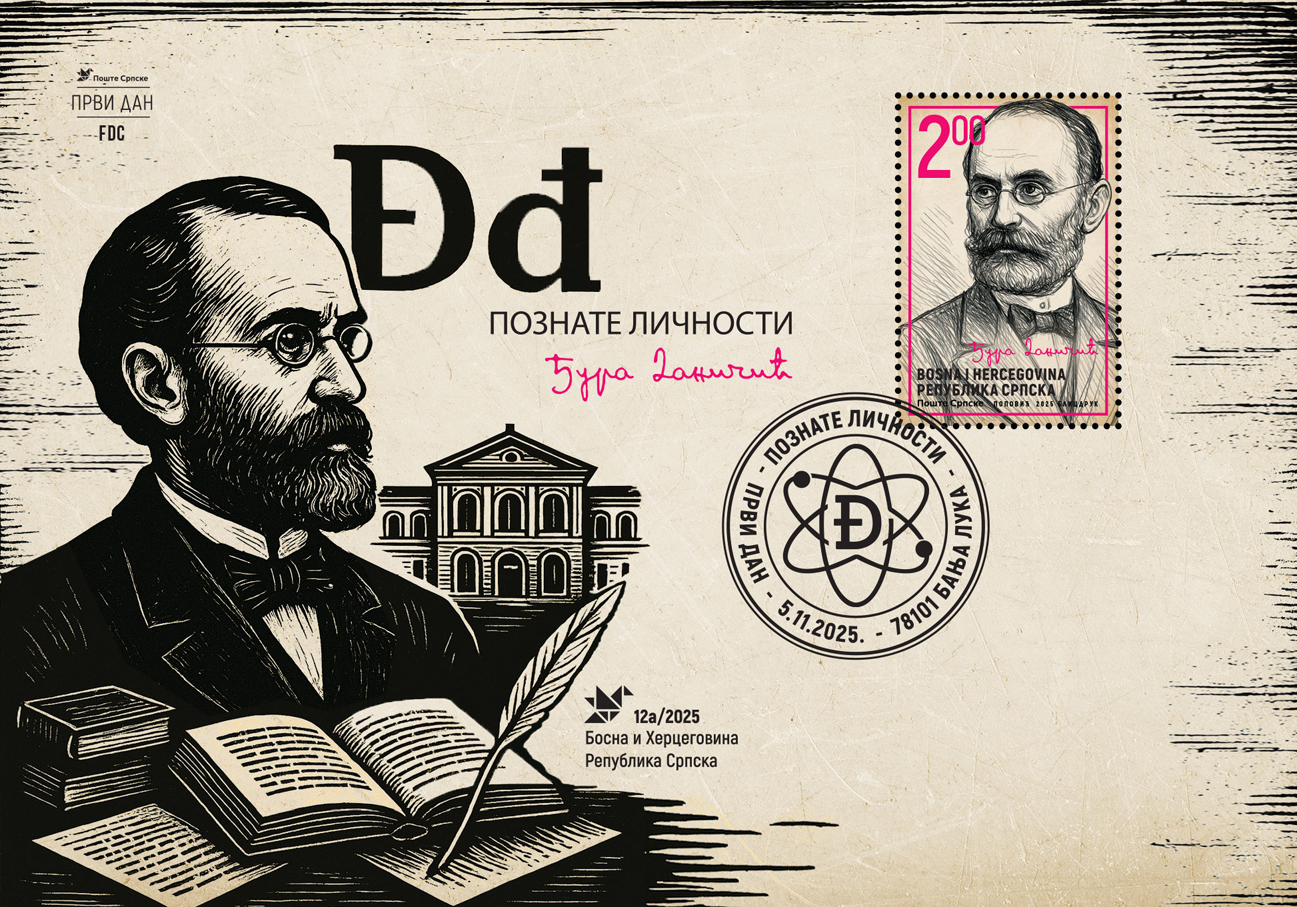
Motive: Djura Danicic
Catalogue no.: 1012
Perforation: 13 3/4
Face value: 2.00 BAM
Quantity: 8 000
Famous People
Mileva Maric Einstein was one of the first women to enroll at the prestigious Polytechnic Institute in Zurich, where she studied physics and mathematics in the late 19th century – at a time when women had almost no access to higher education. She was born in Tittel in 1875 and from an early age showed an exceptional gift for the natural sciences. Her teachers and family recognized her talent early on, and her father strongly supported her in continuing her education, which was very rare for girls at the time.
While studying in Zurich, she met the young Albert Einstein, with whom she developed a close emotional and intellectual bond. Their love later blossomed into marriage, and they had three children together. Although there is no definitive evidence of the extent of her involvement in Einstein's early work, many historians of science still debate whether and to what extent she contributed to his key theories, including the theory of relativity.
Mileva's life was marked by personal and professional challenges. She abandoned her scientific career after marriage, faced with the social expectations of the time. Her marriage to Einstein fell apart, and she later lived a secluded life in Zurich, caring for her sons, one of whom suffered from a severe mental illness.
Today, Mileva Maric is increasingly recognized as a pioneer in the world of science and a symbol of women's struggle for equality in education and scientific work. Her story serves as a reminder of the many women whose contributions to science have long remained in the shadow of their more famous male colleagues.
Author: Danijela Popovic
Publisher: Poste Srpske a.d. Banjaluka
Famous People
Djura Danicic was a Serbian philologist, linguist and one of the most important collaborators of Vuk Karadzic in the reform of the Serbian language. He was born in Novi Sad as Djordje Popovic, and he took the pseudonym "Danicic" after the national hero.
He attended primary school in Novi Sad and Pozun, and law in Pest and Vienna. He was educated mainly in Hungarian, German and Latin. In Pozun he also acquired knowledge of Slovak, Polish, Czech and Russian and already began to translate. During his studies, he was financially supported by Prince Mihailo Obrenovic and Jovan Gavrilovic. In 1856 he became a librarian of the National Library in Belgrade and secretary of the Serbian Literary Society, and in 1859 a professor at the Lyceum (Great School). In 1865, he left his professorship and briefly became a clerk in the Post Office, and in 1866 he went to Zagreb as secretary of the then-founded Yugoslav Academy. In 1873, he returned to the Serbian language department at the Great School in Belgrade, teaching there until 1877.
As a great supporter of Vuk's language reform, Danicic scientifically explained and defended the position that the Serbian literary language must be based on the vernacular. He was among the first to view the Serbian language and literature as a subject of serious scientific analysis, introducing the methods of philology and linguistics. One of his most significant works, written at the age of only 22, is the study "The War for the Serbian Language and Spelling", in which he argued for Vuk's views against critics who opposed the introduction of the vernacular into literature. „Рат за српски језик и правопис“ у којој је аргументовано бранио Вукове ставове од критичара који су се противили увођењу народног језика у књижевност.
His translations of the Old Testament in the vernacular and his linguistic works had a huge impact on Serbian culture. There is almost no area of language that Daničić did not deal with - he wrote scientific works on the history of the language, lexicography, accentology, syntax, and he researched and published old Serbian literature...
Author: Danijela Popovic
Publisher: Poste Srpske a.d. Banjaluka