



Technological inventions
Title: Technological inventions
Date of Issue: 11.06.2026.
Author: Nebojsa Djumic
Type edition: commemorative
Printing techniques: multicolour offset
Sheet: block
Paper: muflep 100g
Printing House: Blicdruk, Sarajevo
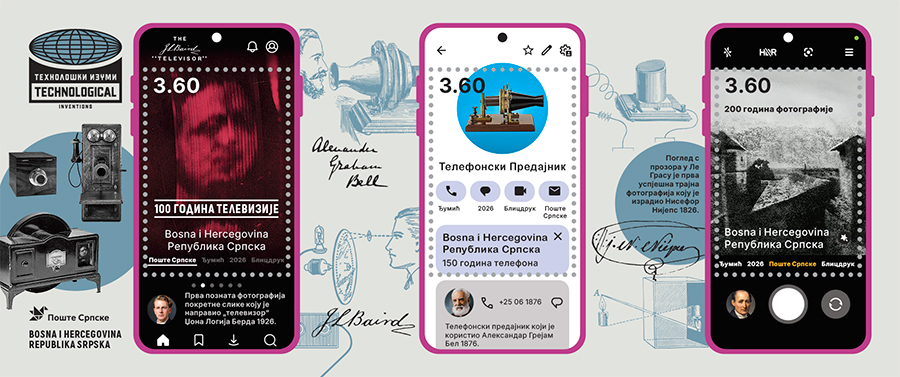
 Motive: photography, telephone, television
Каталошки број: 1027, 1028 и 1029
Perforation: 13 3/4
Nominal value: 10.80 BAM
Quantity: 7 000
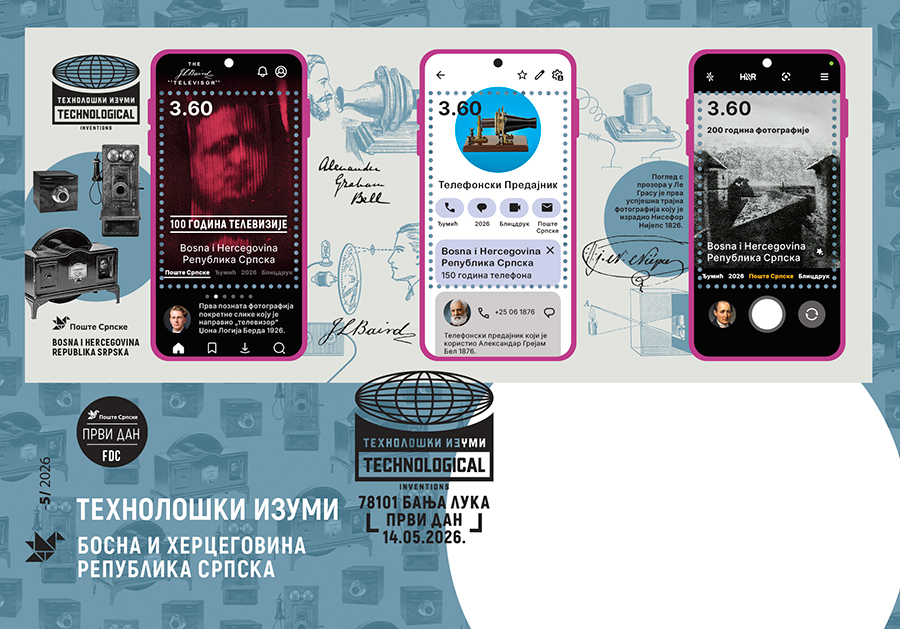
The 19th and first half of the 20th centuries were characterized by incredible technical and technological inventions in the fields of mechanics, optics, acoustics, electricity and electronics, such as photography, long-distance voice transmission and television...
PHOTOGRAPHY – The “father of photography” is the French chemist and inventor Joseph Nicéphore Niépce (1765-1833). After a series of failures in the field of obtaining a permanent photography, Niépce decided in the early third decade of the 19th century to focus all his attention on a special type of asphalt called “Judean bitumen”. He coated a piece of zinc sheet with this asphalt, which, after several hours of exposure in a camera obscura, was first washed with oil and then “bathed” in acid, thus obtaining the first permanent photographs. Although some historians (unfoundedly) claim that Niépce made the first "permanent heliogravures" as early as 1824, the birthday of photography is considered to be 1826, when the world's first preserved photographic record - "View from a Window in Le Grasse" - was taken from the window of Niépce's house in the village of Saint-Loup d'Varennes in eastern France...
TELEPHONE – A telephone is a telecommunications device that allows two people hundreds of kilometers apart to talk to each other. Although history has recorded the attempts of several dozen experimenters to transmit the human voice through a copper wire, but in such a way that the recipient of that “signal” can hear and understand it, the invention of the telephone is attributed to the American scientist of Scottish origin Alexander Graham Bell (1847-1922). On March 7, 1876, he received a patent for a device that, using a membrane and electric current, converted the human voice into a signal, which could (then) be transmitted through wires. Just three days later, while demonstrating the practical application of the telephone at Boston University, Bell called his assistant Thomas Watson, who was in another room, and said to him, “Mr. Watson, come here, I want to see you!” These few words represent the first successful transmission of intelligible human speech over the telephone...
TELEVISION – Television is an electronic system by which images and sound are converted into electrical signals, which are transmitted wirelessly or by cable to a receiver (television), where they are converted back into images and sound. The basic principles of long-distance image and sound transmission were established in 1884 by the German electrical engineer Paul Gottlieb Nipkow (1860-1940). However, it took another four decades for the Scottish inventor John Logie Baird (1888-1946) to significantly improve the functioning of Nipkow's spiral perforated disk and develop a usable mechanical television system, with which he held the first public demonstration of television in black and white technology in London on January 26, 1926...
Graphic realization: Nebojsa Djumic
Publisher: Poste Srpske a.d. Banjaluka
Cooperation: Goran Barac, publicist from Banjaluka